What are you looking for?
Search
How to Read a Watch Dial: A Beginner’s Guide to Markers, Hands, and Complications
How to Read a Watch Dial: A Beginner’s Guide to Markers, Hands, and Complications
A watch dial can look simple at first—until you notice extra hands, small subdials, numbers, scales, and tiny windows.
If you’re new to watches, it’s normal to wonder: What does all of this mean, and how do I read it correctly?
This guide explains the most common dial elements in a clear, beginner-friendly way—so you can understand any watch at a glance.
The Basics: The Dial Parts You’ll See on Most Watches
1) Hour markers
Hour markers help you read time quickly. Common types:
-
Batons: clean, modern, easy to read
-
Arabic numerals: sporty and bold
-
Roman numerals: classic and dressy
-
Indices + minute track: more precise reading
2) The hands (hour, minute, seconds)
Most watches have:
-
Hour hand: shorter, moves slower
-
Minute hand: longer, points to the minute track
-
Seconds hand: sweeps or ticks depending on movement
Internal link insertion (place here):
If you’re still deciding between movement types, our mechanical vs quartz comparison explains why some seconds hands sweep while others tick.
How to Read the Minute Track (So You Don’t Guess)
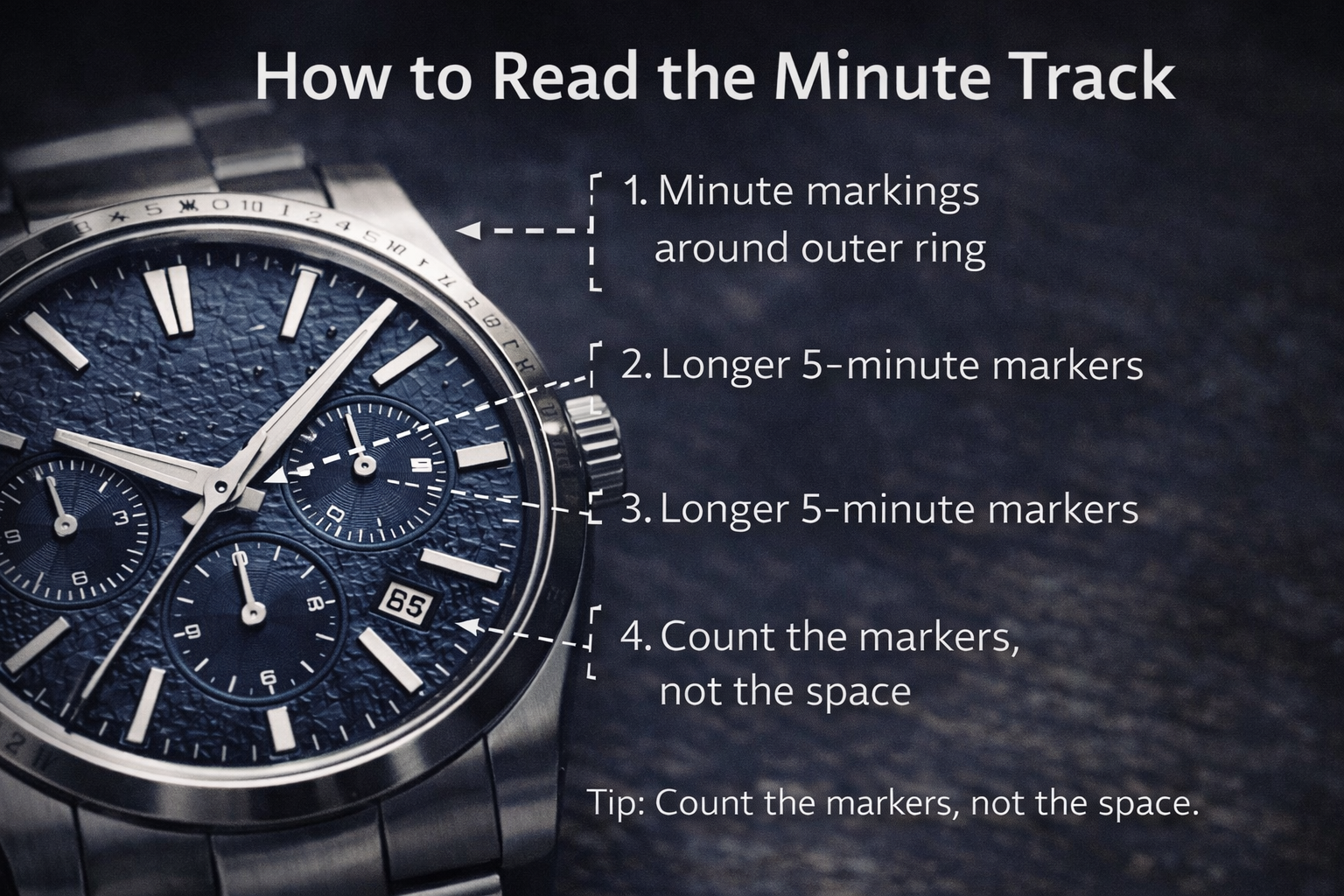
Many beginner mistakes come from ignoring the minute markers.
Look for:
-
Minute hashes around the outer ring
-
Bigger marks at 5-minute intervals
-
Sometimes numbered 05, 10, 15…
Tip: If the minute hand is between two markers, always count the markers—not the distance.
Common Dial Features (And What They Mean)
Date window
Usually at 3 o’clock, sometimes at 6.
If your watch has a date, it may also have:
-
Cyclops lens (magnifier over date)
-
Quick-set date (easier adjustment)
Day-date
Shows both the day and date. Popular for everyday practicality.
Power reserve indicator (automatic watches)
Shows how much energy is left—like a fuel gauge.
GMT hand (second time zone)
A GMT watch typically has:
-
An extra hand (often 24-hour)
-
A 24-hour scale on the dial or bezel
This is great for travelers or people working across time zones.
Subdials Explained: Small Circles, Big Confusion
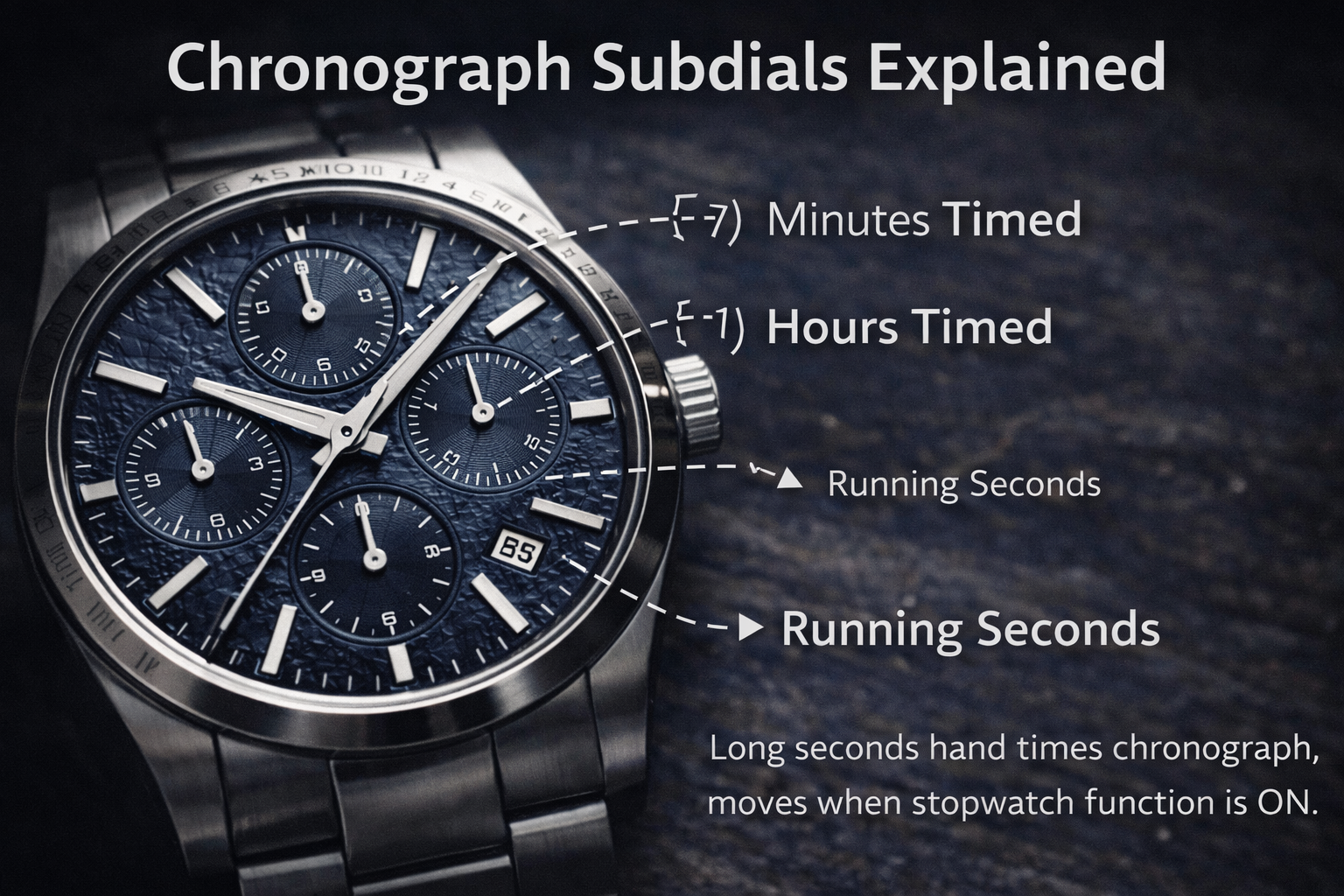
Chronograph subdials (stopwatch function)
A chronograph usually includes:
-
Seconds for the chronograph (often the long seconds hand)
-
Subdials tracking minutes and/or hours you’ve timed
-
Pushers on the case (buttons) to start/stop/reset
Important: On many chronographs, the small subdial is the “running seconds,” while the long seconds hand only moves when timing.
Bezel Scales (The Outer Ring That Actually Does Something)
Dive bezel
Used to track elapsed time—common on dive watches.
Tachymeter
Used to calculate speed over a known distance (typically 1 km or 1 mile).
24-hour bezel (GMT)
Helps track a second time zone.
Internal link insertion (place here):
If you want a watch for daily use, our everyday watch selection guide helps you choose the most practical dial layout and features.
Quick Checklist: How to Understand Any Dial in 10 Seconds
When you look at a dial, do this:
-
Find the hour markers (readability)
-
Identify the hands (which is hour/minute/seconds?)
-
Check for date/day (everyday convenience)
-
Spot extra hands (GMT?)
-
Look for subdials (chronograph or indicator)
-
Read the outer scale (dive bezel/tachymeter)
Internal link insertion (place here):
Before buying, use our watch buying checklist for online orders to confirm dial photos, specs, and return options.
FAQ: Dial Questions Beginners Ask
Why does the seconds hand sometimes tick and sometimes sweep?
Quartz watches usually tick once per second. Mechanical watches often sweep more smoothly.
What’s the difference between a chronograph and a subdial?
A chronograph is a stopwatch function. Subdials can be used for chronograph counters—or other indicators like power reserve.
Is a date magnifier useful?
Yes, if you want quick readability. Some people prefer a cleaner dial without it.
What dial layout is best for everyday wear?
A clean dial with strong contrast, simple markers, and a practical date is usually easiest.
Final Takeaway
A watch dial isn’t complicated once you know what you’re looking at.
Start with the basics (markers + hands), then learn the extras (date, GMT, chronograph, bezel scales).
After that, you’ll be able to understand almost any watch—before you even put it on your wrist.