What are you looking for?
Search
Mechanical Watch Accuracy: What’s Normal? (+/- Seconds per Day Explained)
Mechanical Watch Accuracy: What’s Normal? (+/- Seconds per Day Explained)
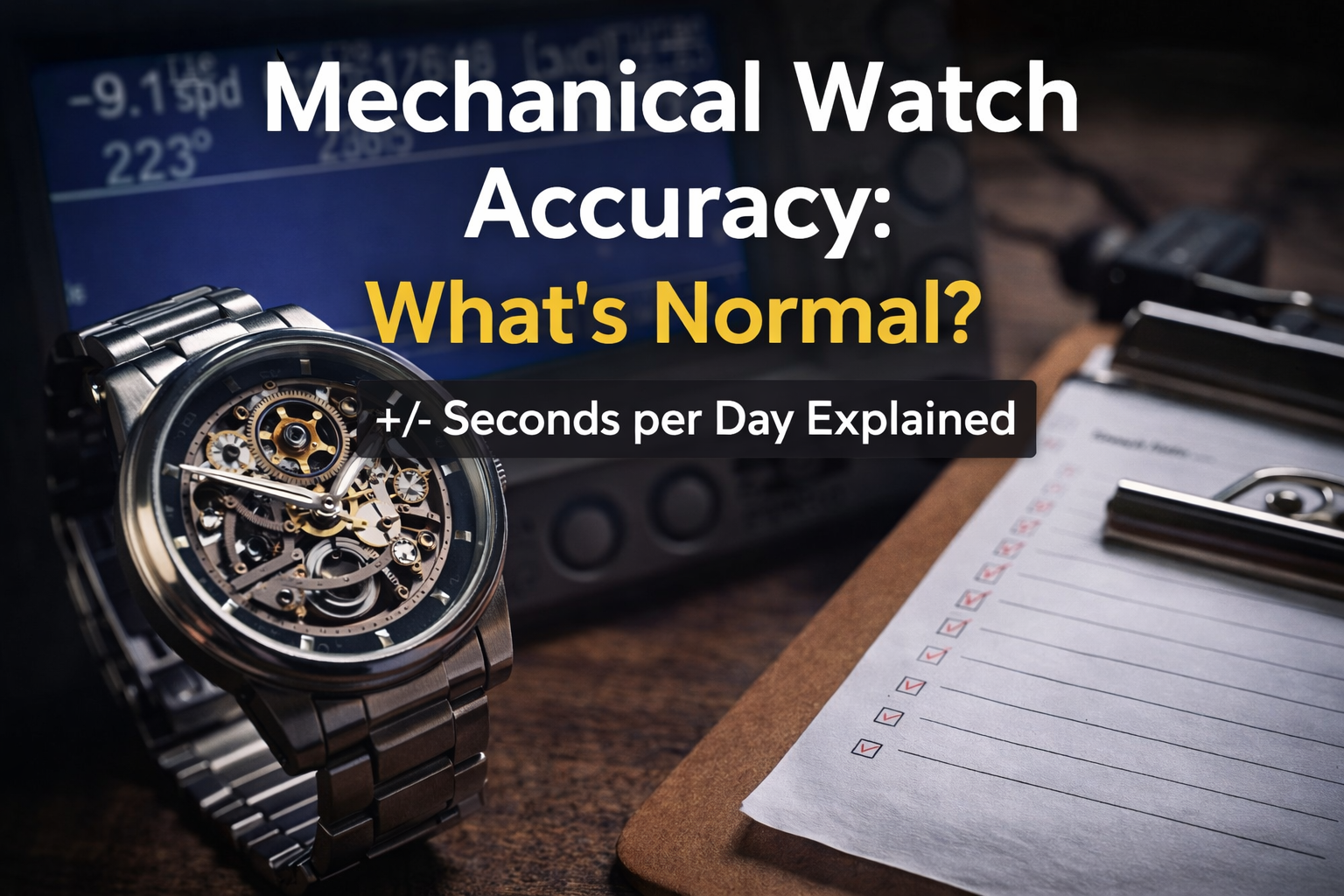
If you’re new to mechanical watches, one surprise is that they don’t keep “perfect” time.
A few seconds fast or slow per day is normal—even for good movements.
In this beginner-friendly guide, you’ll learn:
-
what accuracy actually means,
-
what’s considered “normal,”
-
why a watch gains or loses time,
-
how to measure it correctly,
-
and when it’s time to regulate or service.
Table of Contents
-
Why Mechanical Watches Aren’t Perfectly Accurate
-
What Accuracy Is “Normal” (Seconds Per Day)
-
Common Reasons Your Watch Runs Fast or Slow
-
How to Measure Accuracy the Right Way
-
Regulation vs Servicing: What You Actually Need
-
Quick Tips to Improve Accuracy
-
FAQ
1) Why Mechanical Watches Aren’t Perfectly Accurate
A mechanical watch runs on a balance wheel, springs, gears, friction, and lubricants—not a battery and crystal oscillator.
That means accuracy can change with:
-
position (dial up, crown down, etc.)
-
temperature
-
shock and vibration
-
magnetism
-
lubrication condition (oils dry out over time)
If you’re deciding between mechanical and quartz mainly for accuracy, this comparison helps:
Mechanical vs Quartz Watches: Which Is Better for You?
2) What Accuracy Is “Normal” (Seconds Per Day)
Accuracy is usually discussed as seconds gained or lost per day (s/day).
Typical real-world accuracy ranges
-
Entry-level mechanical watches: often within ±10 to ±30 s/day
-
Well-regulated mechanical watches: commonly ±5 to ±15 s/day
-
High-grade / chronometer-grade movements (when well adjusted): can be around ±2 to ±10 s/day in daily wear
Important: Real-world wear varies. A watch that’s “perfect” on one wrist can run differently on another due to movement, temperature, and daily routine.
The key beginner takeaway
If your mechanical watch is off by a few seconds to a couple dozen seconds per day, that can still be normal.
What matters is consistency (stable pattern), not perfection.
3) Common Reasons Your Watch Runs Fast or Slow
1) Magnetism (very common)
A magnetized hairspring can stick slightly, often making the watch run fast.
Common sources:
-
phone speakers
-
laptop/tablet covers
-
magnetic clasps
-
wireless chargers
Clue: sudden big change (e.g., from +8 s/day to +60 s/day).
2) Position (how you rest the watch)
Mechanical movements run differently in different positions.
For example, some watches run faster “dial up” and slower “crown down.”
Clue: accuracy changes depending on how you store it at night.
3) Low power reserve / not fully wound
If your watch is running low on power, amplitude drops and timekeeping can drift.
Clue: accuracy gets worse near the end of the day or after not wearing it.
4) Shock / vibration
A bump can affect regulation or cause small issues over time.
5) Temperature
Extreme heat or cold can change how the balance spring behaves.
6) Dry oils / overdue service
As lubricants degrade, friction increases and accuracy becomes inconsistent.
Clue: timekeeping becomes erratic, not just “a steady +10 s/day.”
4) How to Measure Accuracy the Right Way (Simple Method)
Don’t judge accuracy from memory. Use a consistent method.
Step-by-step (beginner friendly)
-
Set your watch to an accurate time source (phone time is fine).
-
Write down the exact time you set it.
-
Wear it as you normally do for 24 hours.
-
After 24 hours, compare your watch to the same time source.
-
Record the difference in seconds.
Repeat for 3–5 days to find the pattern.
What to record
-
Daily gain/loss (e.g., +12 s/day)
-
Any changes in routine (desk day vs active day)
-
Where you store it at night (dial up, crown down, etc.)
Pro tip: Consistency over 5 days tells you far more than one day.
5) Regulation vs Servicing: What You Actually Need
These are not the same.
Regulation (adjusting the rate)
If your watch is running consistently fast or slow, a watchmaker can often regulate it (fine-tune timekeeping).
Regulation is best when:
-
the watch is healthy,
-
accuracy is stable,
-
but you want it closer to zero.
Servicing (maintenance/overhaul)
Servicing is needed when:
-
accuracy becomes inconsistent,
-
the watch has low power reserve,
-
there are signs of wear, dryness, or internal friction,
-
or the service history is unknown and performance is poor.
Beginner rule:
-
Stable but off? Consider regulation.
-
Unstable or worsening? Consider service.
If you buy mechanical watches online, make sure you ask about service history and performance. This checklist helps you avoid costly surprises:
How to Buy a Watch Online Safely: The Complete Beginner Checklist
6) Quick Tips to Improve Accuracy (Without Tools)
Here are practical things you can do immediately:
1) Fully wind it (even automatics)
If your watch allows manual winding, give it a full wind occasionally to keep amplitude stable.
2) Try “night positioning”
If your watch runs fast, store it in a position that tends to slow it slightly (often crown down).
If it runs slow, try dial up (varies by movement).
Do this experimentally and track results for 3 nights.
3) Keep it away from magnets
Don’t rest your watch on laptop speakers, tablet cases, or magnetic chargers.
4) Avoid extreme temperature changes
Hot showers + cold AC cycles are not ideal for consistent timing.
Final Thoughts
Mechanical watches are tiny machines. A small daily gain or loss is normal.
What you want is a predictable pattern—and a clear plan if things change.
If you’re choosing your first watch and want a simple fit + lifestyle approach, start here:
How to Choose Your First Watch: A Complete Beginner’s Guide
FAQ
What’s a normal accuracy range for a mechanical watch?
Many mechanical watches run within roughly ±10 to ±30 seconds per day in real-world wear. Better-regulated watches can do better, but perfection isn’t the goal.
Why is my mechanical watch suddenly running fast?
Magnetism is a common cause. If the change is sudden and large, consider having it demagnetized.
Is it bad if my watch loses 20 seconds per day?
Not necessarily. If it’s consistent and you’re okay resetting occasionally, it can be normal for many mechanical watches.
Should I regulate my watch or service it?
If it’s stable but simply fast/slow, regulation may help. If it’s inconsistent, worsening, or has unknown service history with poor performance, servicing is more likely needed.