What are you looking for?
Search
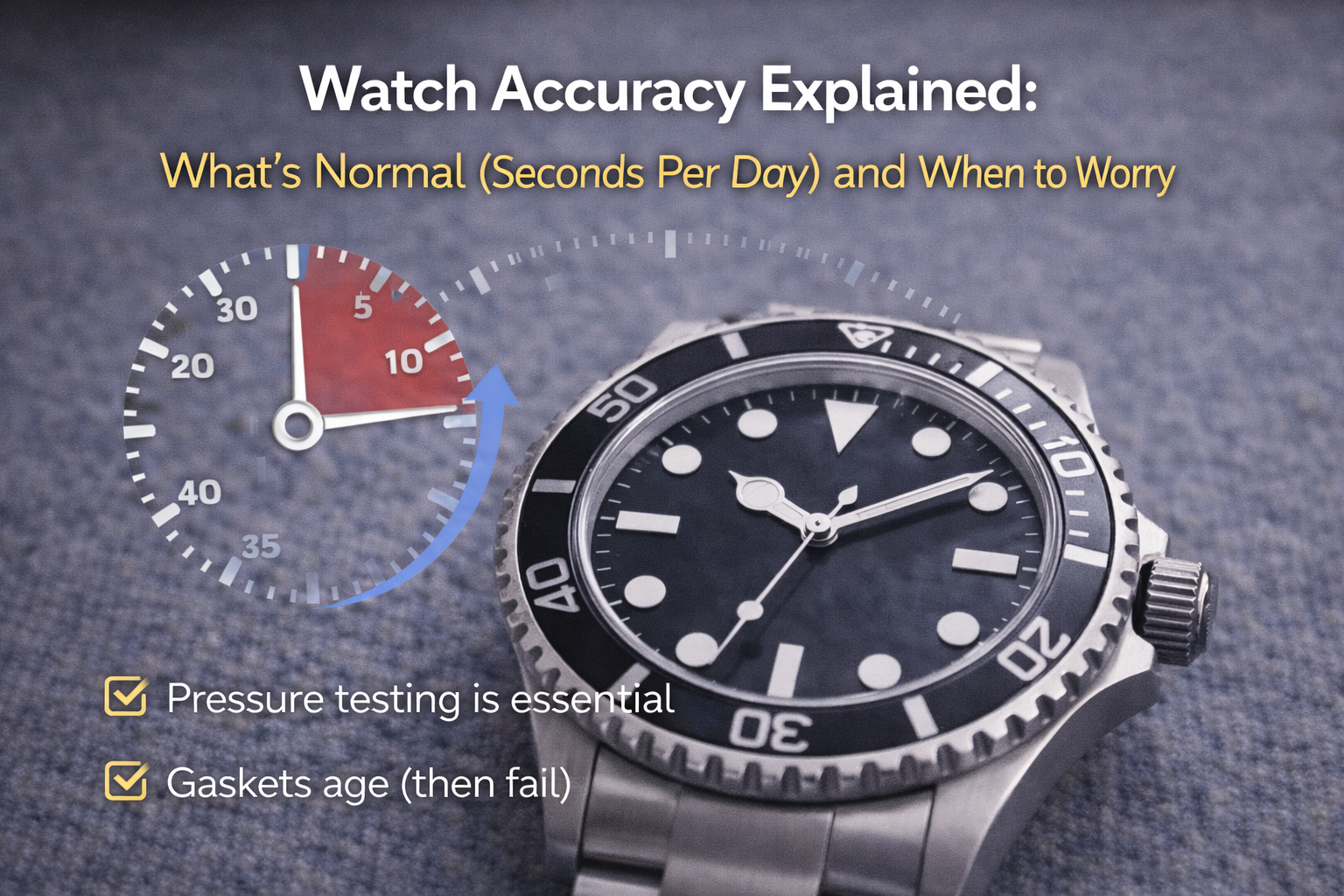
Watch Accuracy Explained: What’s Normal (Seconds Per Day) and When to Worry
Watch Accuracy Explained: What’s Normal (Seconds Per Day) and When to Worry
Introduction
Most people notice watch accuracy when something feels “off”—your watch is suddenly minutes ahead, or you’re adjusting it every week. But not all drift is a problem. Every watch has a normal accuracy range, and it depends heavily on whether your watch is quartz or mechanical.
In this guide, you’ll learn:
-
normal seconds-per-day ranges (simple benchmarks)
-
why accuracy changes
-
quick fixes you can try
-
signs it’s time for a professional check
1) The Two Accuracy Worlds: Quartz vs Mechanical
Before numbers, it helps to know what you’re measuring.
Quartz watches
Quartz watches regulate time using a vibrating quartz crystal and an electronic circuit. They’re generally far more stable day-to-day.
Mechanical / automatic watches
Mechanical watches use a balance wheel and escapement—tiny moving parts affected by friction, temperature, position, and magnetism.
If you’re still choosing between movement types, see: Mechanical vs Quartz Watches: Key Differences Explained.
2) What’s “Normal” Accuracy? (Simple Benchmarks)
Here are practical ranges most people can use.
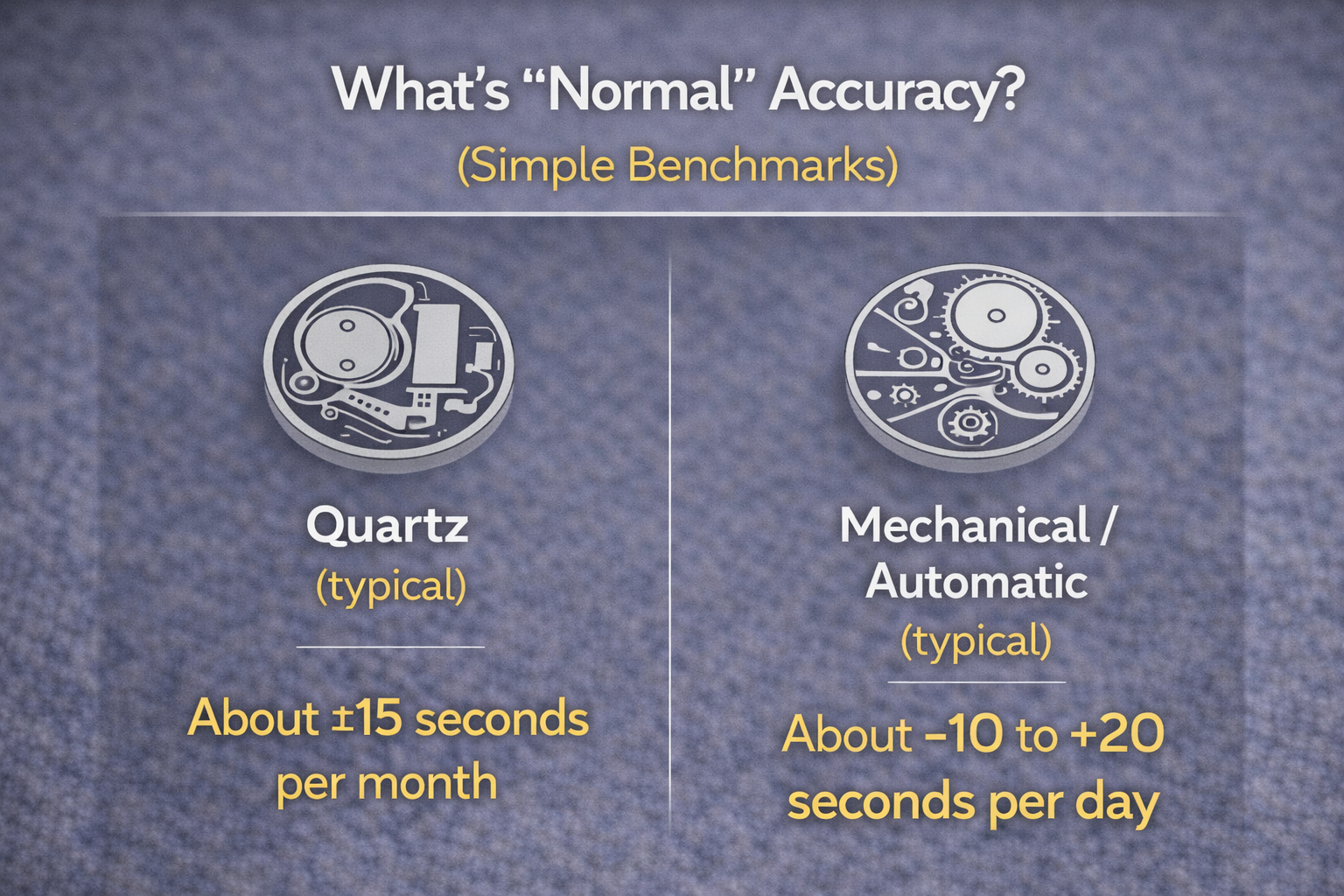
Quartz (typical)
-
About ±15 seconds per month is common
-
Some are better, some cheaper models worse
If a quartz watch is drifting minutes per week, that’s usually not normal.
Mechanical / Automatic (typical)
A normal range depends on movement quality, condition, and how it’s worn, but for many everyday mechanical watches:
-
About -10 to +20 seconds per day can be normal
-
Better-regulated watches may be tighter
-
Some watches vary more based on position and wear habits
Important: A watch can be “within spec” and still annoy you. That’s where regulation and lifestyle tips help.
3) Why Your Watch Accuracy Changes Over Time
Even if nothing “broke,” accuracy can drift due to:
-
Magnetism (common with chargers, speakers, phone cases)
-
Position (dial up vs crown down can change rate)
-
Shock/bumps (tiny alignment changes)
-
Temperature swings
-
Low battery (quartz behavior changes)
-
Old oils / dried lubrication (mechanical friction increases)
If your watch has never been checked and it’s been years, accuracy drift can be a service signal. See: Watch Service Explained: When to Service Your Watch (And What It Costs).
4) Fast Troubleshooting: What You Can Try at Home
For Quartz Watches
-
Check the battery
If the seconds hand is “jumping” or the watch is inconsistent, it may be a low battery. -
Clean the caseback area (basic hygiene)
Sweat and grime won’t change the timekeeping directly, but it can affect crown feel and general wear. If you want a safe routine: How to Clean a Watch Safely: Bracelet, Case, and Crystal (At Home Guide).
For Mechanical Watches
-
Fully wind it (even if it’s automatic)
Low power reserve can reduce stable amplitude and worsen accuracy. -
Try different resting positions overnight
A simple “position hack” can offset your daily gain/loss. Example:
-
If the watch runs fast on your wrist, try resting crown-down overnight.
-
If it runs slow, try dial-up (this varies by watch).
-
Avoid magnets immediately
Move it away from wireless chargers and magnetic phone stands.
5) Magnetism: The #1 Modern Accuracy Killer
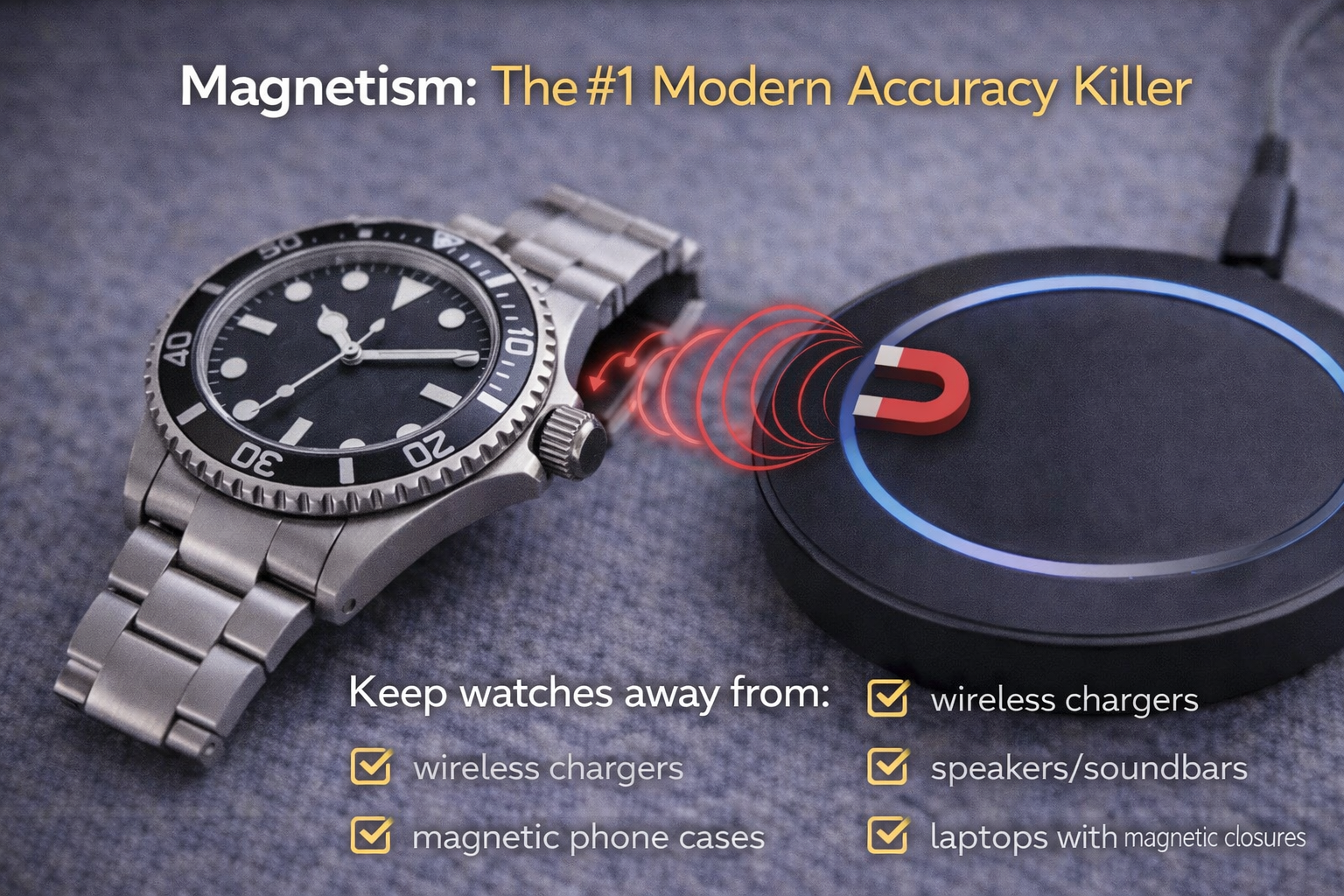
Many modern accuracy complaints are magnetism. If your mechanical watch suddenly starts running much faster, magnetism is a top suspect.
Keep watches away from:
-
wireless chargers
-
speakers/soundbars
-
magnetic phone cases
-
laptops with magnetic closures
-
some desk accessories
If you suspect magnetism, a watchmaker can demagnetize quickly in many cases.
(And if you want to prevent this long-term, storing watches correctly matters. See: How to Store Your Watches Properly: Avoid Scratches, Moisture, and Battery Damage.)
6) When Accuracy Means “Service Time”
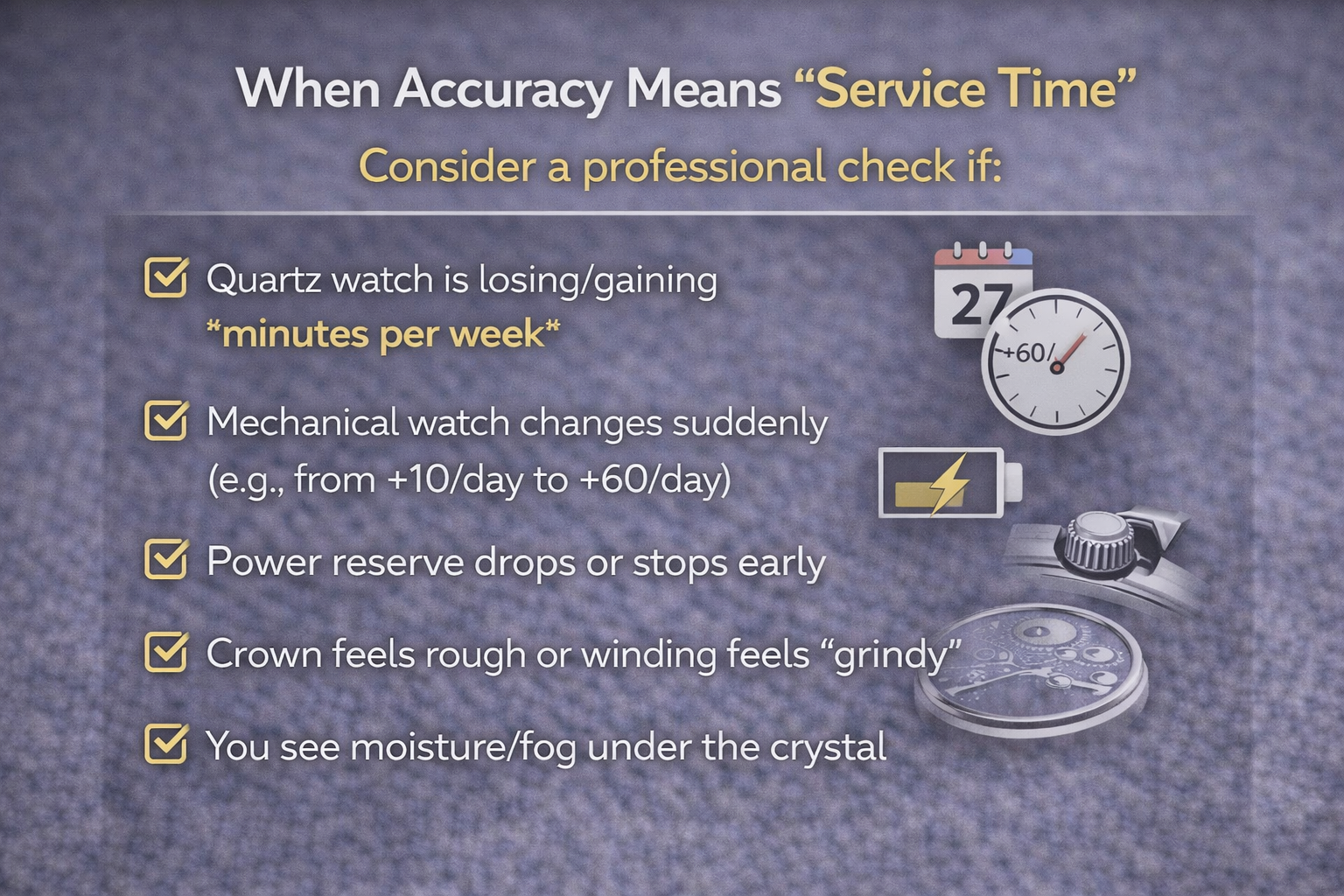
Accuracy issues can be a normal trait—or a warning sign. Consider a professional check if:
-
A quartz watch is losing/gaining minutes per week
-
A mechanical watch changes suddenly (e.g., from +10/day to +60/day)
-
The watch stops early or power reserve drops
-
The crown feels rough or winding feels “grindy”
-
You see moisture/fog under the crystal
If you have any water exposure, seals may also be involved. For water basics: Watch Water Resistance Explained: What 30m, 50m, 100m Really Mean.
7) What Accuracy Can You Expect After Regulation?
Regulation is not magic, but it can improve everyday wear results.
-
Many mechanical watches can be regulated to a tighter range depending on movement quality and condition.
-
If the watch is worn parts / dried oils, regulation alone may not hold—service may be needed.
The goal is not “perfect.” The goal is stable and predictable.
Quick Summary (The Practical Rule Set)
-
Quartz should usually be accurate enough that you barely notice drift week-to-week.
-
Mechanical watches can drift daily—and that can still be normal.
-
Sudden big changes often point to magnetism, shock, or service needs.
-
Your lifestyle (chargers, storage, water exposure) matters more than people think.
FAQ
Q1: Is it normal for an automatic watch to lose 20 seconds a day?
It can be normal for some watches, depending on movement and condition. If it suddenly changes or worsens, investigate magnetism or service needs.
Q2: Why is my mechanical watch suddenly running fast?
Magnetism is one of the most common causes. Wireless chargers and magnetic phone accessories are frequent triggers.
Q3: How accurate should a quartz watch be?
Many quartz watches are around ±15 seconds per month, but it varies. Minutes per week usually indicates a battery or movement issue.
Q4: Can resting position really change accuracy?
Yes. Mechanical watches can run differently depending on position due to gravity effects on the balance and escapement.
Q5: Should I demagnetize my watch myself?
It’s safer to have a watchmaker do it, but demagnetizing is often quick and inexpensive.