What are you looking for?
Search
How to Store Your Watches Properly: Avoid Scratches, Moisture, and Battery Damage
How to Store Your Watches Properly: Avoid Scratches, Moisture, and Battery Damage

Introduction
A watch can last decades—but storage mistakes can ruin it in months. Scratches, moisture, magnetism, and even battery leaks are some of the most common causes of preventable damage.
Whether you own one daily wearer or a small collection, this guide will show you practical, easy storage rules that protect your watches and keep them ready to wear.
1) Keep Watches Away From Moisture (Even If They’re “Water Resistant”)

Water resistance doesn’t mean a watch is immune to humidity. Over time, seals age, temperature changes create condensation risk, and moisture can quietly cause corrosion.
Best practices:
-
Store watches in a dry room, away from bathrooms and kitchens.
-
If you live in a humid area, add silica gel packs inside the storage box.
-
If you ever see fog under the crystal, stop wearing the watch and get it checked.
If you’re still unsure what your rating actually allows (30m vs 100m), use this guide: Watch Water Resistance Explained: What 30m, 50m, 100m Really Mean.
2) Prevent Scratches With Soft Surfaces and Smart Spacing

Most scratches happen off the wrist—watches rubbing against other watches, keys, zippers, or metal accessories.
Do this:
-
Store each watch in an individual slot or cushion.
-
If using a drawer, use a soft watch roll or cloth-lined tray.
-
Keep bracelets and cases from touching each other (especially polished steel).
Quick rule: If your watches can clink together, they will scratch each other.
3) Avoid Magnetism: It Can Make Your Watch Run Wrong
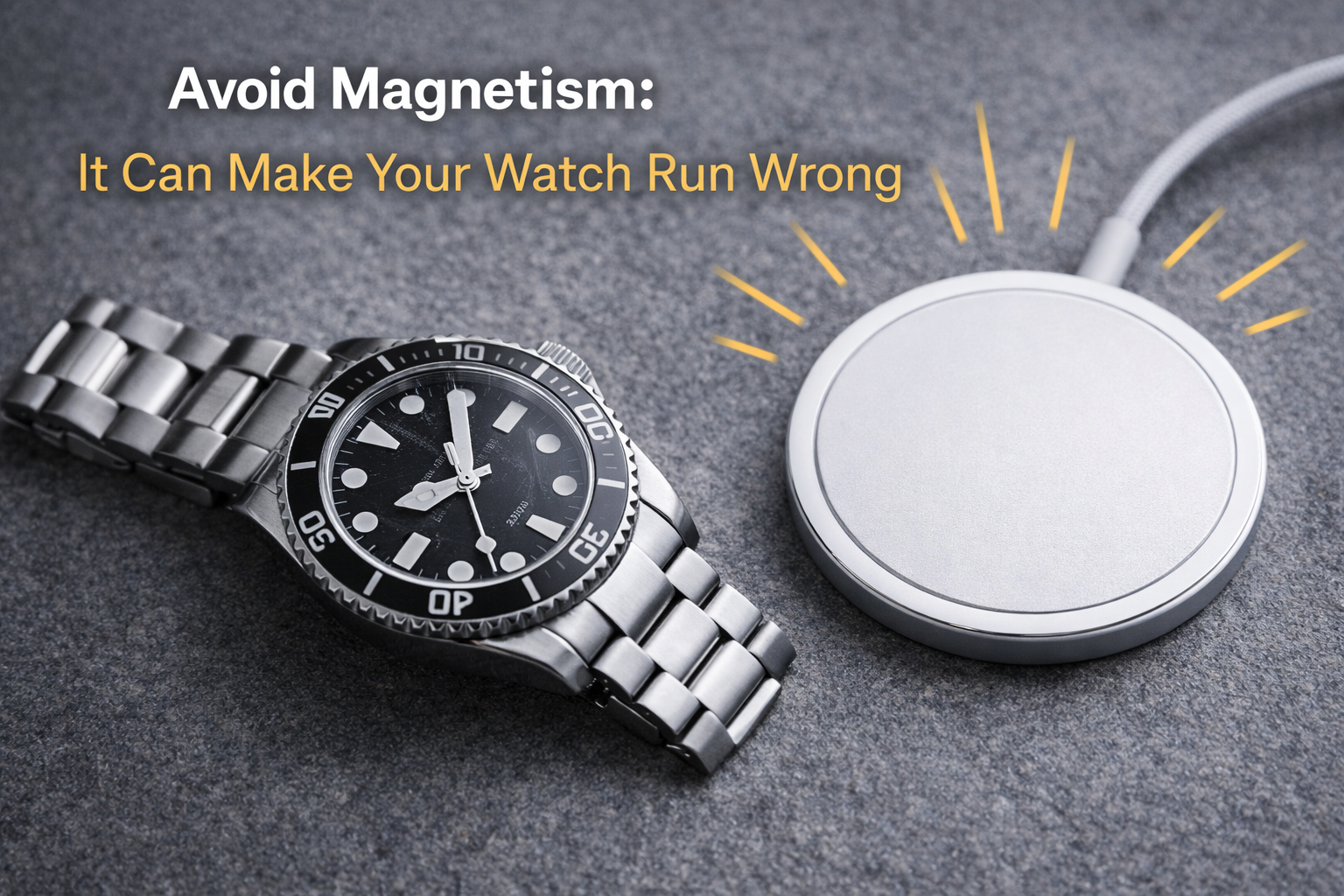
Magnetism is an underrated problem. Strong magnets can affect mechanical movements and cause timekeeping issues.
Keep watches away from:
-
Speakers and soundbars
-
Phone/tablet magnetic cases
-
Wireless chargers and MagSafe docks
-
Laptop lids and some desk accessories
A watch that suddenly runs fast/erratic may simply be magnetized—often fixable, but avoidable.
For accuracy basics and what’s “normal,” read: Watch Accuracy: What’s Normal and How to Improve It.
4) Battery Care for Quartz Watches (Prevent Leaks)
If you store a quartz watch for a long time, the battery can eventually leak and damage the movement—sometimes beyond economical repair.
Safe storage rules for quartz:
-
If you won’t wear it for 6–12 months, consider a battery check/removal (depends on your watch and how long you’ll store it).
-
Don’t store a dead-battery quartz watch for “years.”
-
If the seconds hand is jumping in 2–4 second steps (on many models), change the battery soon.
If you’re deciding which type is better for your lifestyle long-term, this comparison helps: Mechanical vs Quartz Watches: Key Differences Explained.
5) Should You Use a Watch Winder?
A watch winder is optional—not mandatory. It’s mainly about convenience.
A winder can make sense if:
-
You wear an automatic watch often and want it ready
-
Your watch has a complicated calendar you dislike resetting
Skip a winder if:
-
You rotate watches occasionally (resetting is fine)
-
You prefer minimizing movement wear while stored
Tip: If you use a winder, keep the setting conservative. Over-spinning is unnecessary.
6) Temperature and Sunlight: Don’t Store Watches Like Cosmetics
Extreme heat, direct sunlight, or rapid temperature shifts can damage seals and degrade straps.
Avoid storing watches:
-
on a windowsill in direct sun
-
near radiators/heaters
-
in a car glove box long-term
Leather straps especially suffer from heat and humidity.
7) The Best Storage Options (Simple Ranking)
Here’s a practical “best to budget” ranking:
-
Watch box with individual cushions + silica packs (best all-around)
-
Watch roll (best for travel + minimal storage)
-
Soft-lined drawer tray (good if you keep spacing)
-
Leaving it on a desk/nightstand (worst for scratches and knocks)
Quick Checklist: The “Safe Storage” Standard
If you only remember one checklist, use this:
-
✅ Dry place (add silica if needed)
-
✅ Soft separation (no metal-on-metal contact)
-
✅ Away from magnets/chargers
-
✅ Quartz batteries monitored
-
✅ Moderate temperature, no direct sun
FAQ
Q1: Is it okay to store watches in the bathroom?
Not recommended. Steam and humidity increase moisture risk even if the watch is water resistant.
Q2: Should I store my watch in its original box?
It’s fine for short-term. For long-term, make sure the environment is dry and the watch won’t rub against hard surfaces.
Q3: Do automatic watches get damaged if they aren’t worn?
No. Storing an automatic watch is normal. Just keep it clean, dry, and away from magnets.
Q4: Can silica gel really help?
Yes—silica gel helps reduce humidity inside a closed watch box, which lowers corrosion and fog risk.
Q5: What’s the biggest storage mistake?
Letting watches touch each other (scratches) and storing quartz watches long-term with dead batteries (leak risk).